
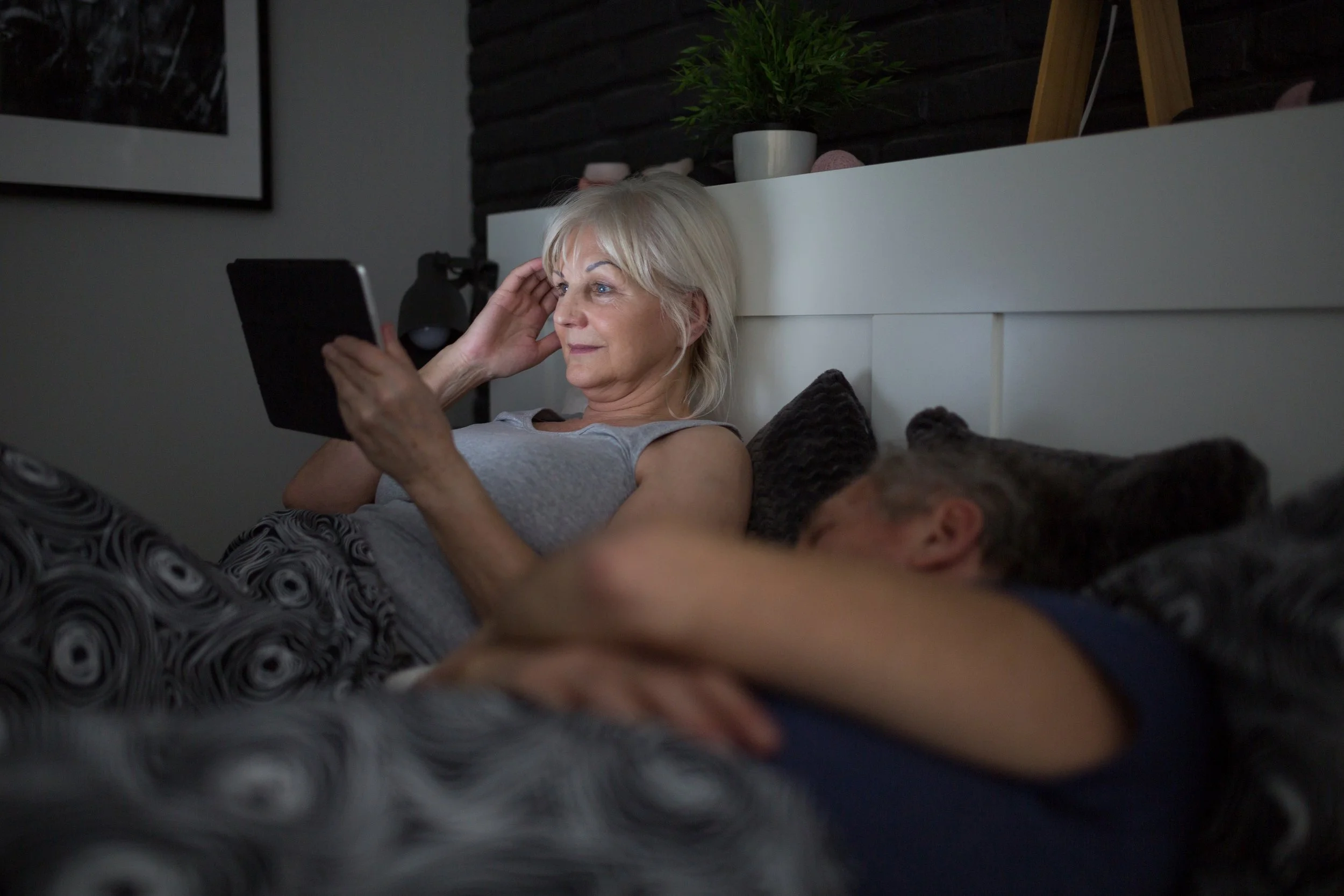
At our most recent Community Conversation, we got talking about something many of us do before bed or when sleep just isn’t happening: reach for a digital device.
Some people read books on an iPad. One person listened to an audiobook. I admitted that I sometimes look through old photos of Bella. In fact, about half of our group said they use a digital device in some way to help themselves wind down or get back to sleep.
Wait a minute. Aren’t screens—and especially blue light—supposed to be terrible for sleep?
It’s not quite that simple. Blue light matters, but we may have oversold the blanket advice to avoid screens before bed.
Yes, Evening Light Can Affect Your Body Clock
Light is one of the strongest signals our brain uses to regulate our internal 24-hour clock. Evening light, particularly shorter-wavelength, or “blue,” light, can suppress melatonin, increase alertness, and shift our circadian timing later.
But the effect depends on more than whether a screen is present. Research shows that brightness, timing, duration, wavelength, and distance from the eyes all matter (1).
We Don’t All Respond the Same Way
This is the part I find fascinating.
In one experiment, researchers measured how 55 adults responded to different levels of evening light. The amount of light needed to suppress melatonin by 50% ranged from about 6 lux to 350 lux—more than a 50-fold difference between the most and least light-sensitive participants (2).
In other words, the same evening light exposure can affect two people very differently.
The Screen May Not Be the Whole Story
A 2024 National Sleep Foundation expert panel reviewed research on screens and sleep across the lifespan. For adults, the panel did not reach consensus that screen use in general, the content viewed before bed, or the light from screens impairs sleep. The evidence simply wasn't strong or consistent enough to say so (3).
For kids and teens, however, the evidence was clearer. The panel concluded that screen use in general can impair sleep in children ages 5–12 and adolescents ages 13–19. They also concluded that the content viewed before sleep can interfere with sleep in these age groups. However, the panel did not reach consensus that the light from screens itself impairs sleep in children, teens, or adults.
So the takeaway isn't simply “blue light is bad.” For younger people, both overall screen use and what they're doing on those screens deserve attention. For adults, the evidence is less certain, and individual responses may vary.
So…Do You Need to Put Your Device Away?
Maybe. Maybe not.
Instead of making this another sleep rule, make it an experiment. Notice what happens when you use a screen before bed or during the night. Does it make you feel more awake? Keep you up longer than you intended? Or does reading quietly, listening to something soothing, or looking at old photos help you settle?
If you suspect your screen is getting in the way, try dimming it, using a warmer nighttime setting, shortening your screen time, or putting it away for a few nights. Then see whether your sleep changes.
Perhaps the question is not, “Is blue light bad for sleep?”
It may be, “How does evening light—and what I do with my screen—affect my sleep?”